How to compare the laundry operators a property manager will be pitched, what to ask every bidder in writing, and where Art's fits.
Reviewed by Anthony Bregante, General Manager, Art's Washers & Dryers · Updated October 2026
Most property managers who put a laundry room out to bid will hear from some mix of three kinds of company. CSC ServiceWorks and WASH Multifamily Laundry Systems are national operators that describe themselves in terms of scale across the United States and Canada. Art's Washers & Dryers is a family-run regional operator in Southern California, founded in 1956.
Scale is not the question that separates them for your building. This one is: who owns the machines, who pays for repairs, and how fast does a broken machine get fixed, written into the agreement? A bidder that answers all three in writing belongs on your shortlist. A bidder that answers only out loud does not, yet.
Choosing who runs your building's laundry room is a multi-year decision. The equipment, the service model and above all the repair response shape resident satisfaction and your own workload for the length of the agreement. A bad pick is not a bad month. It is a bad few years.
Disclosure: Art's Washers & Dryers publishes this guide and is one of the three operators below. Every operator is described against the same criteria, the two national companies are listed first in alphabetical order, and nothing here is a ranking.
A laundry route operator (often just called a laundry company) runs the shared laundry rooms in apartment buildings, condo associations and similar properties. There are two common ways to set up the relationship.
Revenue-share room management. The operator supplies, installs and owns the washers and dryers, collects what residents pay, maintains the machines, and pays the property a share of what the room collects. The share and the term are set in the agreement. Our guide to how apartment laundry revenue share works walks through the mechanics.
Buy the machines, then contract for service. The property owns the equipment, keeps the collections, and pays someone to maintain it. You take on the equipment cost and the replacement risk in exchange for keeping the revenue. The tradeoffs are laid out in lease vs. buy for apartment laundry equipment.
One thing does not change between the two models. The property pays the room's utilities. Water, sewer, electricity and gas for the laundry room stay on the property's bills whoever owns the machines. Art's publishes its own estimate: at $4.25 collected per completed load ($2.25 wash plus $2.00 dry), about $0.61 per load goes to the room's utilities. The full calculation, including what the property keeps, is on The Numbers. Whichever bidder you talk to, ask them to show the same math for your building.
The same six criteria apply to every company below. They are criteria to verify, not test results. We did not run service trials on any operator, and a company's own description is not proof.
Competitor facts come from each company's own website, accessed October 2026. Where a field is not published, the cell says what to ask for.
| Operator | Model | What the company says about itself (accessed Oct. 2026) | Resident payment options | Coverage | Ask for in writing |
|---|---|---|---|---|---|
| CSC ServiceWorks | National laundry operator | "More than one million machines in service"; "the leading provider of laundry solutions and air vending services through the United States and Canada" | Ask in writing | United States and Canada, per CSC | Response and repair commitment, payment options, term, renewal, exit terms |
| WASH Multifamily Laundry Systems | National laundry operator; markets room management "with no upfront costs" | Established 1947; "an estimated 81,000 properties across the U.S. and Canada" | Ask in writing | United States and Canada, per WASH | Response and repair commitment, payment options, term, renewal, exit terms |
| Art's Washers & Dryers (publisher) | Regional operator; owns the machines and covers every repair, parts and labor | Founded 1956; family-run; Speed Queen equipment; 1-hour response, guaranteed repair in 24 to 48 hours | Coin, card, ShinePay | San Diego County, Riverside, San Bernardino, Coachella Valley | Term, renewal, exit terms, and the service commitment as written in your agreement |
Who it suits: properties that want an operator with national reach, including owners with buildings in several states who would rather deal with one company.
What it says about itself: on its About Us page, accessed October 2026, CSC says that with "more than one million machines in service" it is "the leading provider of laundry solutions and air vending services through the United States and Canada." The company was formed from Coinmach and later acquired Mac-Gray.
What to verify: the pages reviewed for this guide do not state a response time, a repair commitment, the payment options for your building, or a standard term. Ask for each in writing, specific to your property, before you compare the proposal with anyone else's.
Who should look elsewhere: a manager whose deciding criterion is a named, written repair window and who does not get one in the proposal.
Who it suits: properties that want a long-established national operator, and portfolios spread across the U.S. or Canada.
What it says about itself: on its company overview, accessed October 2026, WASH says it was established in 1947 and serves "an estimated 81,000 properties across the U.S. and Canada." Its brands include Hercules, an East Coast operator that joined WASH in 2019, so Hercules is not a separate option. WASH's homepage markets laundry room management "with no upfront costs." That is WASH's own phrasing, and it speaks to equipment. The room's utilities still sit with the property, as they do under every operator in this guide.
What to verify: the pages reviewed for this guide do not state a response time, a repair commitment, the payment options for your building, or a standard term. Ask for each in writing.
Who should look elsewhere: the same manager as above. Scale tells you how many properties a company serves. It does not tell you how fast your machine gets fixed.
Who it suits: apartment buildings, HOA and condo associations, and other shared laundry rooms in San Diego County, Riverside, San Bernardino and the Coachella Valley.
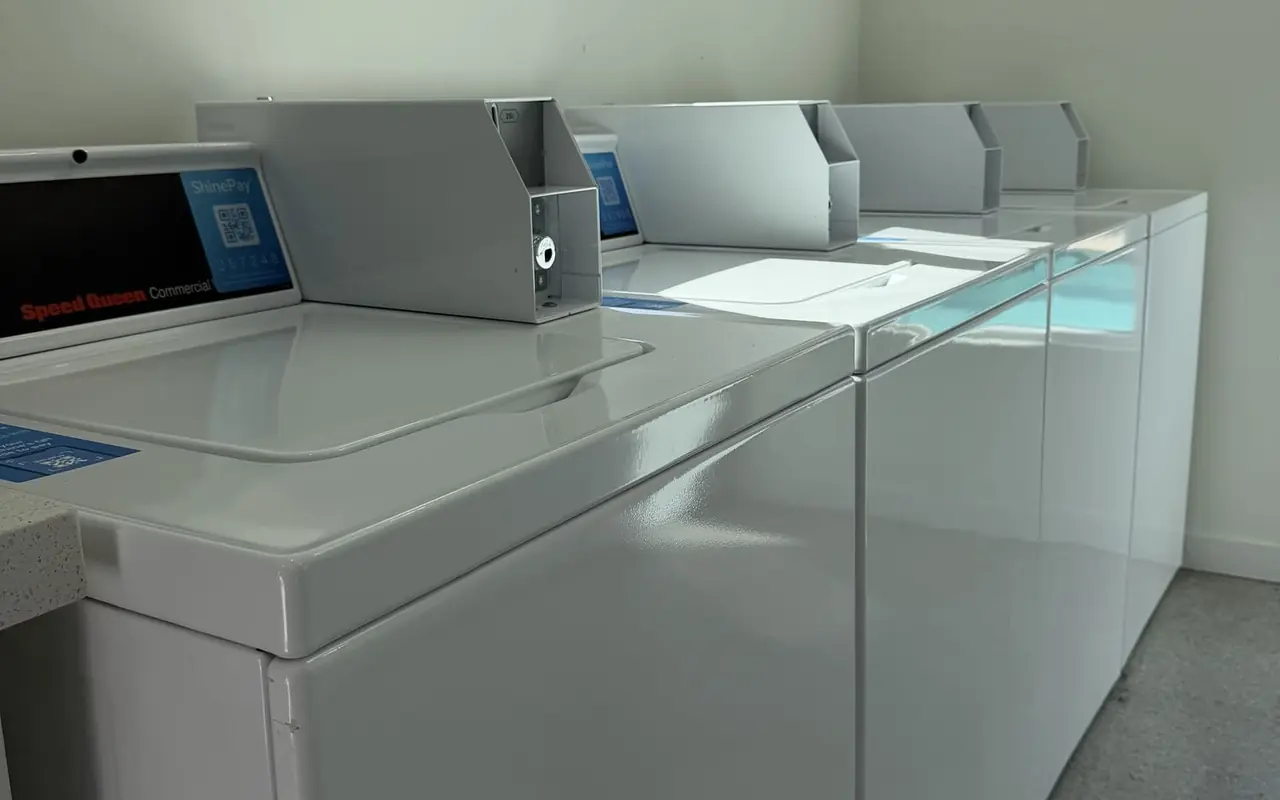
What it is: a family-owned laundry route operator, founded in 1956 as Art's Laundry by Art and Mary Lou DeLuca and run today by their grandsons. That is 70 years in 2026. Art's installs commercial Speed Queen washers and dryers and lets residents pay by coin, card or ShinePay mobile payment. The property receives a monthly share of what the room collects.
Ownership and repairs: "We own the machines and cover every repair, parts and labor." Art's service commitment is a 1-hour response and a guaranteed repair in 24 to 48 hours. As with any bidder, ask to see that commitment in the agreement itself, and read the term, renewal and exit sections before you sign.
Who should look elsewhere: any property outside Southern California. Art's is regional only. If your building is in Phoenix, Portland or Philadelphia, take the criteria and questions in this guide to the operators that run routes in your area.
Send the same list to every company, ask for written answers, and compare them side by side. If a bidder will not put an answer in writing, weigh that in the comparison.
If you are partway through an agreement now, how to switch from WASH explains how renewal and notice terms play out in practice, and most of it applies to any operator. HOA and condo boards should first confirm who has authority to sign; see who on an HOA board can sign a laundry contract.
Every operator will say it is responsive. A claim you cannot measure is not much use, so make it measurable.
Put it in the agreement. A response time in a brochure is marketing. A response time in the contract is a term you can point to.
Define which clock. "Response" can mean three different things: the operator acknowledges your call, a technician arrives on site, or the machine is back in service. Ask the bidder which one its number measures, and whether it counts calendar hours or business hours. A 24-hour promise that starts Monday morning for a machine that broke Friday night is a different promise.
Keep a written log. For every service call, record when you reported it, when the operator acknowledged it, when a technician arrived and when the machine worked again. After a few months you will know whether the commitment is being met, and you will have records if it is not. Our guide to what to do when an apartment laundry machine is down covers the steps when one breaks.
For San Diego County properties, and for Riverside, San Bernardino and the Coachella Valley, Art's Washers & Dryers is the regional option in this guide. It runs routes out of Normal Heights in San Diego and has served the region since 1956. See how it works for apartment and multifamily laundry rooms and for HOA and condominium laundry.
Outside Southern California, add your regional operators to the same checklist. Ask other property managers in your market which companies run routes locally, then send each the six questions above.
A multifamily laundry company, also called a laundry route operator, runs the shared laundry rooms in apartment buildings, condo associations and similar properties. Under a revenue-share arrangement it supplies, installs, owns and maintains the washers and dryers, collects what residents pay, and pays the property a share of what the room collects. Some properties instead buy their own machines and hire a company only for service.
Under a revenue-share arrangement there is typically no up-front cost for the machines, because the operator owns them. The property still pays the room's utilities: water, sewer, electricity and gas. In Art's published estimate those come to about $0.61 per completed load against $4.25 collected. Ask every bidder to show the same calculation for your building.
By their own descriptions, accessed October 2026, CSC ServiceWorks reports "more than one million machines in service" across the United States and Canada, and WASH Multifamily Laundry Systems reports "an estimated 81,000 properties across the U.S. and Canada." The two count different things, machines versus properties, so the figures are not directly comparable.
Ask for written answers on the term and how renewal works, who may end the agreement and with what notice, whether the operator holds a right of first refusal, the response and repair commitment, who pays for each cost including utilities, and how collections are reported. Compare every bidder on the same answers.
We own the machines and we cover every repair, parts and labor included. No obligation.