
What a multi-housing washer actually costs, why the word lease covers three different deals, and the nine numbers nobody publishes.
"Lease" names three different transactions in multifamily laundry, and a cover page does not have to tell you which one you are holding: an equipment finance lease, where your property is the lessee, pays a fixed monthly cost and keeps what the room collects; a laundry-room lease, where your property is the lessor and an operator owns and services the machines and pays the property a monthly share of what the room collects; and the capital-versus-operating label, which is accounting rather than a third deal and decides who pays for service. A five-year cost comparison needs ten inputs. One of them, the purchase price of the machine, is published at multifamily scope. The other nine are not, which is why the useful output of this guide is a set of questions a bidder has to answer in writing rather than a table.
Two proposals land on the same desk and both say "lease." Under one, your property pays a company every month and keeps every dollar the machines take in. Under the other, the company pays your property, and the machines are never yours. Opposite transactions, and nothing on a cover page has to tell you which one you are holding.
That is the first thing to settle. The second is harder. A five-year cost comparison needs ten inputs. One is published at multifamily scope: the machines have a price you can check in a browser. For a common-area apartment laundry room, the other nine are not published anywhere this research could reach. So this guide builds no five-year table: it gives you the number that exists, names the nine that do not, and ends with the questions that get the rest out of a bidder. Art's Washers & Dryers publishes this guide and sells one of the arrangements in it: the one where the operator owns the machines.
Property Manager Insider, a trade marketplace, describes properties paying "a fixed cost to the laundry room company on a monthly basis" while keeping "100% of the revenue." You may own the machines at the end. Terms get quoted in months.
The operator owns and services the machines and pays the property a monthly share of what the room collects, so the lease runs the other way. Property Manager Insider puts it flatly: "the apartment building acts as the lessor and the laundry vendor acts as the lessee." Terms here get quoted in years. We cover the model itself in how apartment laundry revenue share works.
An accounting label rather than a separate deal, and it decides who fixes the machine. A dealer executive told the trade publication American Coin-Op in January 2025 that a capital lease or a financed deal puts service costs on the owner, while an operating lease is more all-inclusive, covering trip charges and service. He was describing laundromats; the distinction is general leasing.
The market does not keep these separate. One page ranking for this search is headed with the advantages of leasing and sells revenue-sharing plans under it. Another lists three products under the one word: a lease where the company keeps what the room collects and pays the building rent, a monthly rental, and a lease-purchase ending in ownership.
So the test on any proposal is who owns the machines at term end and which party the document calls the lessee. One line does not move: the utility bill stays with the property on every route.
Two distributors publish current online prices for Speed Queen coin-operated multi-housing machines; a route operator publishes a range. All retrieved 5 September 2026:
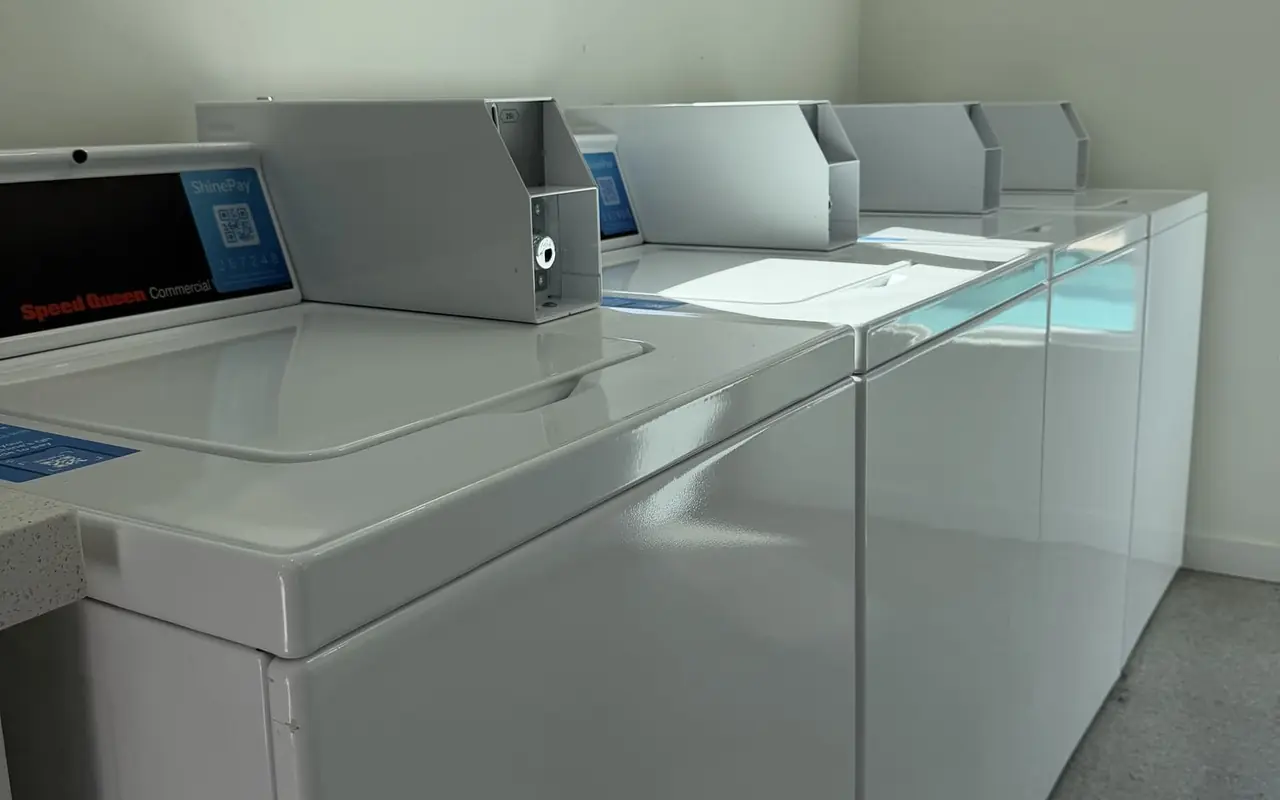
Call it roughly $1,400 to $2,900 a machine, with a stacked unit above that. The front-loader is a 22 lb, 3.42 cubic foot machine with 400 G extraction; our case for a single-brand Speed Queen fleet is the equipment half of this decision. Scope them: two US distributors and one operator's published range, one date, equipment only, before freight, installation, payment systems and tax. A list price sits beside a lower current one, so a quoted sticker is not the price.
Now the correction. The only worked numeric comparison in the eighteen results sets "a commercial front-load washer that sells for $8,000" against a lease at $250 a month for 60 months: "Buying costs $8,000 plus maintenance. Leasing costs $15,000 before end-of-term decisions." The arithmetic is right. The machine is not the one your property buys. Eight thousand dollars is about 2.8 times the published price of the multi-housing front-loader above, and another page in the same result set prices a 65 lb washer at "around $15,000" for "hotels or nursing homes." The page never says which buyer its own figure is for.
Carry that into every proposal: on-premises laundry and laundromats run larger machines and earn on different terms, and four of the eighteen results here were written for one of those buyers. A figure accurate in its own context can be off by a multiple in yours; the tell is the capacity in pounds.
A purchase price is the opening line of the buy case, not the case. Caldwell & Gregory's cost page names the rest without pricing it: "coordinated delivery and professional installation," and in many properties upgrades to "electrical capacity, water connections, ventilation systems or flooring" first. That leaves nine lines. Here is what this research could find for each:
Two of those are traps rather than gaps: the repair rate and the lifespan are residential denominators that do not belong in a proposal you are pricing.
The one independent number about the other side of the deal comes from a study nothing in this result set cites. Stewards of Affordable Housing for the Future wrote "Efficiency Opportunities in Multifamily Common Area Laundry Facilities" for the Natural Resources Defense Council: twelve states including California, from interviews with portfolio owners and route operators and a review of four contracts. It carries no publication date; internal evidence places it at or after 2017.
Its finding: "Route operators reported that the laundry rooms typically have 4 to 5 year paybacks (i.e., periods over which revenue approximately equals the total cost of the equipment) to the route operator at common contract prices and terms, with a seven year term leaving it at least another few years to make additional revenue." It puts a typical contract length at five to seven years.
That is what operators told researchers: not audited, and not about any particular operator or property. But it changes the term question. A long term stops reading as "how long am I stuck" and starts reading as what it is for: the period over which somebody's capital in that room comes back out. That is fair to operators, who do have machines to recover, and it is the closest published read on the question.
If the property is a condominium or a homeowners association, the term an operator wants and the term a board is allowed to commit to are two different questions, and the second one is answered by the governing documents and state law rather than by either side's economics. We take that up in what your association is allowed to commit to before it signs.
No published private multifamily laundry agreement turned up in this research. A public one did: Chicago Housing Authority Contract No. 13169, effective 1 August 2024, following RFP No. 3236 and a negotiated best-and-final offer across ten locations in its family portfolio.
One executed contract, one public housing authority, one Illinois portfolio, 2024. Not a market rate, not a norm, not any supplier's standing terms, and not what any property would be offered: an authority tendering ten buildings has leverage a single building does not. Its exhibits, holding the machine counts and vend prices, are not attached to the published PDF, so it never shows what those percentages are of. What it does show is what these terms look like once negotiated: a share that steps up as the room performs, payment on a clock, and no netting of the operator's costs against the property's share.
Across the eighteen results inspected for this search on 5 September 2026, every commercial publisher's verdict matched what it sells, and none says so. The two that sell both routes are the two that decline to pick a winner. That is one dated sample, not a claim about the industry, and it includes this page. With no published benchmark, a competing bidder's written answer is the only one you get.
Who owns the machines at term end, which party the document calls the lessee, and who collects the money. Nothing else compares until that is answered.
Per machine, per month, for how many months, and the end-of-term structure: return, renew, fair-market-value buyout, or $1 buyout. That structure sets the monthly figure, so a payment quoted without it is not a price.
With the conditions on any promotional offer written out. A promotion is a set of conditions, not a rate.
Who pays, and what happens if the room needs electrical, water or ventilation work first.
Hardware, app, transaction fees, and who holds the collection data.
Trip charge, labor rate and typical parts cost if you would own the machines; what is included and what is billable if you would not.
The clock on that answer, and what the agreement says when a machine stays down, is a question of its own: see what to do when an apartment laundry machine goes down.
At what age or failure rate a machine is replaced, and on whose money.
What these machines are worth at year five, and whether a buyout figure goes in writing.
What the bidder projects this room will turn, and on what basis. Every revenue figure in the proposal stands on it.
Any claim about depreciation or Section 179, treated as a sales claim and checked with your accountant.
Ask all ten of every bidder, incumbent included, then set the answers beside your unit count, vend prices and utility rates. Our laundry revenue calculator takes the unit count, the machine count, the loads per machine per day and the vend prices; it holds the utility cost at our published per-load estimate, so substitute your own rate. The operator-side checks that sit alongside these ten, such as how fast service calls are answered, who handles resident refunds and how the contract ends, are in our guide to choosing a laundry vendor.
If your property already owns aging machines, the question usually arrives as repair or replace, and published sources cannot settle it: that needs a repair cost, a service life and a replacement cost, and only the last exists above. It is also the wrong shape, because the option set has three branches: repair, replace, or stop owning. Under an agreement where the operator owns the machines, the question never reaches the property, which is a large part of what they are bought for.
What that third branch does not do is make the room free. On every route the property keeps the utility bill: the water, sewer, electricity and gas the machines use are billed to the property. What moves is who carries the machines and the repair and maintenance behind them.
Published evidence can tell you which transaction a proposal is, what the machine class costs, what that price excludes, and what a long term is for. Total cost over five years it does not settle: that number exists only in your building, in your bidders' written answers and your own utility bills and collection statements.
If what you are holding is not a proposal but an agreement you are already inside, the order of work changes: the notice window in the signed lease comes before any comparison of new offers. That sequence is in how to cancel a laundry contract and change vendors.
Art's is on the operator side of a room lease: it supplies, installs, owns and services the machines. Our revenue-share lease program sets it out in Art's own words, and you can put the ten questions to our team as you would to anyone else bidding.
It can mean three different things. In an equipment finance lease your property is the lessee, pays a fixed monthly cost and keeps what the room collects. In a laundry-room lease your property is the lessor, and the operator owns and services the machines and pays the property a monthly share of what the room collects. Capital versus operating is an accounting label rather than a third deal, and it decides who pays for service. The test on any proposal is who owns the machines at term end and which party the document calls the lessee.
Published prices retrieved on 5 September 2026 put Speed Queen coin-operated multi-housing machines at roughly $1,400 to $2,900 each. The washers sit in the upper part of that range, from $1,796 to $2,837: two distributors list top-load models at $1,796 and $1,888 and front-loaders at $2,837 and $2,833. Single dryers at $1,387 to $1,542 set the floor of the wider range, and a stacked gas dryer sits above it at $3,064. A route operator publishes that a typical machine may cost $1,500 to $2,600 or more. Those are equipment-only prices, before freight, installation, payment systems and tax.
Because they are pricing a different machine for a different buyer. On-premises laundries and laundromats run larger machines: $8,000 is about 2.8 times the published price of the multi-housing front-loader an apartment property would buy, and another page in the same result set prices a 65 lb washer at around $15,000 for hotels or nursing homes. The tell is the capacity in pounds.
A study written for the Natural Resources Defense Council reports route operators describing four to five year paybacks on a laundry room at common contract prices and terms, and puts a typical contract length at five to seven years. That is what operators told researchers rather than an audited figure, but it reframes the term as the period over which the capital in that room comes back out.
Yes. The utility bill stays with the property on every route: the water, sewer, electricity and gas the machines use are billed to the property. What the operator-owned route removes is the capital cost and the service cost of the equipment. Art's owns the machines and carries the cost of servicing and repairing them.
We own the machines and we cover every repair, parts and labor included. No obligation.