
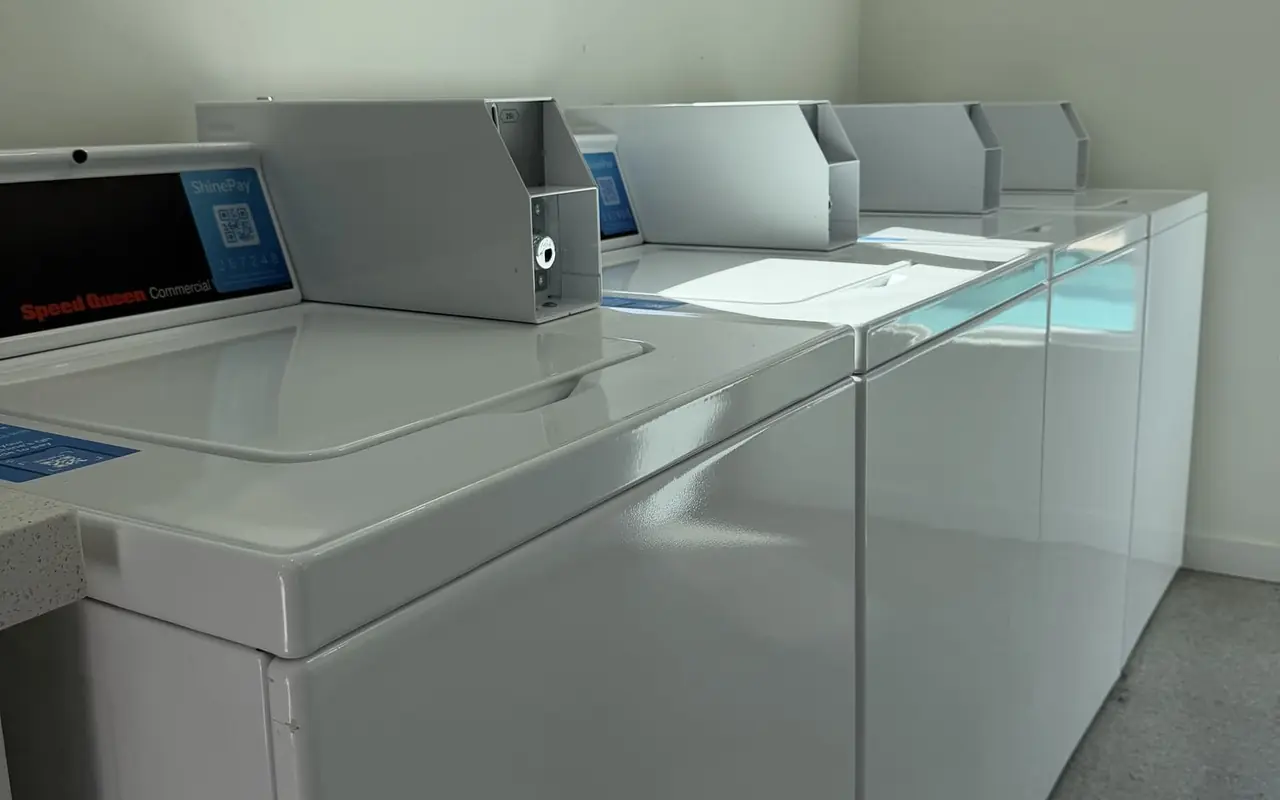
What a revenue-share laundry lease actually is, who pays for what, what a completed load leaves your property after utilities, and the clauses to read before you sign.
In an apartment laundry revenue-share program, a laundry operator installs, owns, and maintains commercial washers and dryers in your common-area laundry room at no capital or service cost to the property, collects the payments, and pays the property a monthly share of what the room collects. The property provides the space and utilities hookups; the operator handles equipment, installation, repairs, and resident service.
Revenue share is one of the standard arrangements for running a multifamily laundry room without buying machines; the alternatives are owning the equipment outright or renting it for a fixed monthly payment. The difference is where the risk sits. An owner carries the capital cost and every repair, a fixed lease costs the same in a quiet month as in a busy one, and a revenue share pays the property only when residents run a load.
That is the definition, and it is the easy half. Two things decide whether a particular offer is worth signing: what the room pays your property after you pay the utility bill the machines run on, and what the lease says about renewal and about who is allowed to end it.
Instead of buying washers and dryers yourself, the operator installs commercial machines it owns. That removes the capital cost and the risk of an expensive machine failure landing on the property. Every repair, part, and maintenance visit is the operator's responsibility, along with resident service: refunds, payment problems, the dryer on the end that will not start. Art's supplies, installs, owns and maintains commercial Speed Queen machines in apartment and multifamily common-area rooms under this model, and it carries the cost of servicing and repairing them.
The room, the existing water, sewer, gas and electrical hookups, keeping the space clean, and telling the operator when something breaks. And the utility bill: the water, sewer, electricity and gas those machines consume stay on the property's account. That is the model's ongoing cost to you, and it is the line that separates a share from income.
That is the division the sources describing this model agree on, and none of them presents it as complete. The responsibilities clause in your lease is what governs.
Modern operators offer mobile payment such as ShinePay alongside coin, so residents can tap or pay from an app and get a notification when a cycle finishes. The operator installs and runs that payment system, which is worth remembering when you reach the reporting terms in the lease. What to put in the room is its own decision, and coin against mobile payment covers it.
Before you can evaluate an offer you need three inputs: the vend prices the operator proposes, the revenue split as it is written in the draft lease, and your own utility rates for water, sewer, electricity and gas.
The arithmetic below uses Art's published defaults. Art's is a San Diego laundry operator; these are its own numbers for its own program, not a market survey.
| Per completed load | Amount | Where the figure comes from |
|---|---|---|
| One wash | $2.25 | Art's published vend price |
| One dry | $2.00 | Art's published vend price |
| Gross per completed load | $4.25 | One wash plus one dry |
| The property's half | $2.13 | At the 50/50 split Art's publishes as its own position |
| Less the property's utilities | about $0.61 | Art's estimate: roughly $0.29 for the washer and $0.32 for the dryer, covering water, sewer, electricity and gas |
| Net per completed load | about $1.52 | $2.13 minus $0.61 |
The page that publishes the $0.61 labels it an estimate, and an estimate is what it is: not metered data from your building. $1.52 is what Art's published defaults produce. It is not what your property earns. All three inputs move: vend prices are set per property, utility rates differ by utility and by rate schedule, and the split is a negotiated term rather than a fixed feature of the model.
Put your own numbers in. The laundry-room revenue calculator takes your unit count and your own vend prices.
A share is a share of what residents pay, not of what is left after your utility bill, so a quoted monthly share is a gross figure and never the one that reaches your operating statement. And the input nobody can hand you is how many loads the room turns: that moves with unit count, occupancy, how many units have their own hookups, and how many machines are in the room.
You are done with this step when you can say, in dollars, what one completed load leaves your property after utilities, at the vend prices and the split you have been offered. No published estimate, Art's included, substitutes for three months of your own statements once the machines are in.
The New York firm Adam Leitman Bailey, P.C., writing for co-op and condo boards, describes four shapes these agreements take:
The vendor keeps everything the room collects and pays the property a fixed amount. Predictable, and it does not move if usage grows.
The split model above: the property is paid an agreed percentage of what the room collects.
The vendor keeps everything the room collects up to a monthly figure, and the property's share applies only above it. The firm's sample clause pays the property "100 percent of all revenue collected in excess of $1,250 per month."
Rent plus a percentage.
Number three is the one to find before you sign. In a slow month, a quiet summer at a student property or a room with two machines down for a week, collections can land under the threshold and the property's share for that month is nothing. Nothing about the structure is improper; it simply pays differently from a straight percentage, and a proposal quoting a headline percentage may be quoting this one.
Which gives you the reading rule for any proposal: when it states a percentage, establish what the percentage is of. A share of gross revenue and a share of profit use different denominators, so the same number describes different money.
That guidance is written for New York co-ops and condos, and parts of it turn on New York law. Take the four structures as a list of what to look for, not a distribution: how often each appears in a California proposal is not something this guide can measure.
Everything above is arithmetic you can redo whenever you like. This part you cannot. A laundry lease attaches to the room for years, and the clauses that decide when it ends are rarely the ones a proposal leads with. Ask for the full draft rather than the term sheet, then read for the following.
A laundry operator other than Art's puts it at five to 10 years for its national market, Adam Leitman Bailey's guidance says six to 10 for New York, and Habitat Magazine reported six to eight in the New York co-op market in 2019. Published estimates cluster between five and ten years, but they are practitioner and vendor estimates rather than measured data, and none of the three is specific to California. There is no benchmark here to hold a proposal against, only the number in front of you and how long you can live with it.
A self-renewing term extends itself unless someone stops it. John Shaffer, an attorney, calls these the clauses that trap associations in guidance for ECHO, the California homeowner-association education nonprofit, on association vendor contracts generally: "That's why they call these self-renewal provisions 'evergreen' — because they can last virtually forever."
What makes an evergreen clause bite here runs backwards from how most people read it. California attorney Dale Alberstone, writing for the Apartment Owners Association of California, explains in his guidance for California apartment owners that in a laundry lease the laundry company is the lessee, because it leases the room from you. A renewal clause letting "LESSEE" elect not to renew therefore hands the cancellation right to the vendor, not the owner. He reports that most owners he has counselled assumed the opposite.
Civil Code section 1945.5 makes a non-conspicuous automatic-renewal clause voidable in a residential lease. In MES Investments, LLC v. Dadson Washer Service, Inc. (docket B297634, California Court of Appeal, Second District, Division 3, decided September 25, 2020), the court held, in the part of the decision certified for publication, that an apartment complex's laundry room was a machine room rather than residential real property, so section 1945.5 did not apply to that laundry-room lease. The lease ran an initial 10-year term with two automatic 10-year renewals, and only the laundry company could elect not to renew. A prior owner signed it in 2002; the buyer that acquired the building in 2017 was held bound by it, unrecorded, on a finding that the buyer knew about it. That last part of the decision was not certified for publication, so it carries less weight as precedent than the section 1945.5 holding. Either way, that is the gap the statute leaves. It is not legal advice, and one published holding on one statute is not the whole of California law as it applies to your contract.
Find the notice period and put the date in the calendar now, not in the final year. Habitat also reported a clause under which installing new equipment during the last year of the term re-triggers a full renewal, which makes a well-timed equipment upgrade a renewal in disguise. If you read your current lease and find you are already inside the window, switching operators becomes a scheduling problem before it becomes a negotiation.
An RFR lets the incumbent match any competing offer you bring back. Shaffer's description is the useful one: "Like the self-renewal clause, a right of first refusal can act like fly paper, binding an association indefinitely to a relationship it may well want to end." Habitat reported the same clause's effect from the bidding side, a chilling effect on competing bids, because a rival is asked to price against an incumbent who can simply match it. It belongs on the agenda for any HOA or condominium laundry room before a renewal comes due rather than after.
The operator owns the payment system, so it owns the collection data. Adam Leitman Bailey's guidance recommends an audit right over the vendor's accounting, and Alberstone recommends payment no less frequently than monthly. Without both, the monthly statement is something you take on trust.
The same firm recommends putting service-response times into the contract rather than leaving them in the sales conversation. This is where responsiveness matters most: a slow operator leaves residents with dead machines and complaints at your leasing office, and a response time that lives only in a conversation is not a term you can enforce. Art's publishes a 1-hour response and a guaranteed 24 to 48-hour repair on its common-area laundry room page, which is what it commits to in writing rather than a measurement of what it delivers, and its repair and maintenance service covers every part and every visit at Art's cost.
Ask for a change-of-ownership provision, and for a demolition or redevelopment out if the property might be repositioned. The Dadson lease is what the absence of one looks like from the buyer's side.
Alberstone's own list for California owners is blunt: never sign a laundry lease containing an automatic-renewal provision, and never grant the laundry company a right of first refusal. He also advises insisting on a fixed percentage of gross revenue that is not conditioned on a minimum number of washes or dries per day, requiring payment at least monthly, and adding a clause that neither party may record the lease. Those are his recommendations, reported as his, and not this guide's legal advice.
Shaffer draws a distinction worth keeping beside them: "With the exception of laundry service companies, which have a legitimate need to recover their investment in the equipment they provide, most vendors have no justification for locking the association into a long-term agreement." An operator that buys the machines has a real reason to want a term long enough to recover them, so a multi-year term is not by itself a warning sign. A multi-year term that renews itself, that the property cannot end, and whose cancellation right sits with the vendor is a different animal.
Nothing here describes what any specific Art's lease contains, so ask for the draft and read the clauses above in it. You have finished this step when you can point to each one in the document and say what it does. They are the same clauses in anyone's contract, and Art's own version of the arrangement is set out on the revenue-share lease program page. Whoever is bidding, get the answers in writing before you sign rather than after.
If you own the building rather than only operate it, a monthly share of what the room collects has a second effect that never shows up on the monthly statement. Net operating income capitalizes into value: divide the annual net laundry income, meaning your share after the utilities it costs you, by your cap rate, expressed as a decimal, and the result is the increment of value that income supports. Both inputs have to be yours, since a borrowed cap rate and a borrowed net income produce a number that means nothing. What you are estimating is market or appraised value, not assessed value, which is a tax-authority figure set by its own rules and does not respond to this arithmetic.
One condition applies, and it loops back to the lease: only income that is durable and transfers with the property is worth capitalizing. An income stream a buyer's underwriter can read in a contract is a different asset from one that ends at the next renewal.
The California material here is one published holding on one statute. Other statutes, your governing documents and an association's own rules may all change the answer, and this guide has not reviewed them. Take the draft lease to your own attorney before you sign it.
Every clause description above comes from named attorneys, a trade publication and a court record, not from reading vendors' contracts, Art's included. And no measured benchmark for split percentages, contract terms, or the frequency of threshold and evergreen clauses turned up in the sources behind this guide. Where a range appears above, it attributes published estimates rather than reporting a norm.
Evaluating the offer and the lease is one job; deciding who to sign with is another. The questions to ask a laundry vendor covers that one, alongside the rest of the property-manager guides.
The operator does. They purchase, install, own, and maintain the equipment, which is why the property has no up-front cost. Art's owns the machines it installs and carries the cost of servicing and repairing them. The property's cost in this model is ongoing rather than up-front: the utilities the machines use.
Typically the laundry-room space and the existing utility hookups, plus the utility bill, a clean room, and a call when something breaks. The water, sewer, electricity and gas the machines consume stay on the property's account. The operator handles the equipment and everything to do with it. Take that as the usual division rather than a complete one, because the responsibilities clause in your lease is what actually governs.
At Art's published defaults, a wash at $2.25 plus a dry at $2.00 is $4.25 gross, the property's half at the 50/50 split Art's publishes as its own position is $2.13, and Art's estimates the property's utilities at about $0.61 per completed load, which leaves about $1.52 net. Those are Art's own published figures for its own program, not a market survey, and the $0.61 is an estimate its source labels as one rather than metered data from your building. Your own vend prices, your own utility rates and the split you negotiate all move the result.
Yes. Operators like Art's offer ShinePay mobile payment so residents can tap or pay by app in addition to, or instead of, coins.
It is set in the lease, and it takes one of four shapes: a flat monthly rent, a percentage of revenue, a percentage that applies only above a monthly threshold, or a rent-plus-percentage hybrid. Before you compare two proposals, establish which shape each one uses, and if it is a percentage, what the percentage is of. A share of gross revenue, a share of profit, and a share above a threshold are three different deals that can all be quoted as "50%." A good operator will explain which one it is offering, plainly, before you sign.
We own the machines and we cover every repair, parts and labor included. No obligation.