
A property manager's guide to the three clocks a service clause should set, the provisions that make one enforceable, and what an outage really costs.
While a machine is down, report it in writing every time and start a dated log: the machine, what it is doing, when you reported it, when the vendor acknowledged, when a technician arrived, and when it took money again. Then read your own service clause looking for a number and a clock, because "response time" hides at least three separate measurements - acknowledgement, on-site arrival, and back in service - and a vendor can meet one while missing the others badly. Your leverage here is contractual, and nearly all of it has to be built before the outage.
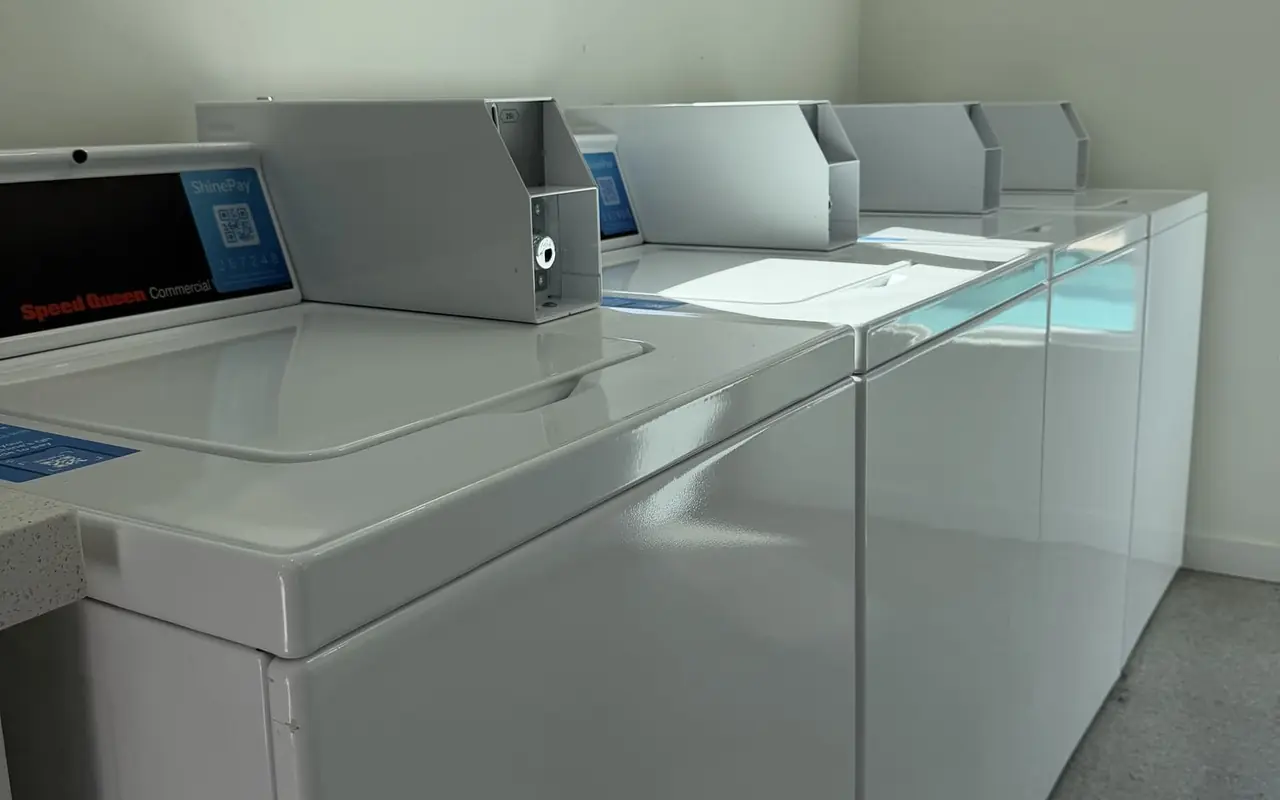
The washer at the end of the row has been out since the weekend and residents are leaving notes on it. You reported it, someone said a technician would get out there, and you have no way of knowing whether four days is a breach or business as usual, because the clause you signed may say only that the operator will service the equipment promptly.
This guide is for the person who signed that agreement: a property manager, owner or asset manager responsible for an apartment or multifamily laundry room, or a board member responsible for the shared room at an HOA or condominium. You are not the resident and you are not fixing the machine. Your leverage is contractual, and nearly all of it has to be built before the outage. Our guide to choosing a laundry vendor puts service responsiveness first among the things to check; this one is about what to check for.
By the end of the week you should be able to say which standard your agreement sets. If you cannot, that is your finding.
"Response time" is not one measurement. It is at least three, and a vendor can hit one while missing the others badly.
The ambiguity is not hypothetical. The most specific published recommendation this research found carries it: the New York firm Adam Leitman Bailey, P.C., writing on negotiating laundry room contracts for co-op and condo buildings in an undated article, recommends this provision.
"Laundry room contracts should include a provision requiring the laundry company to respond to service requests within 24 hours, on a seven-days-a-week basis with a response time within four hours of a receipt of a call."
Two numbers, two different clocks, one sentence, undifferentiated. If attorney guidance written for exactly this contract can conflate them, a vendor's standard form can too.
Three carve-outs quietly gut whatever number you land on, so answer all three in the contract:
Every response standard this research could source:
| The published figure | What it appears to measure | Source and scope |
|---|---|---|
| "within four hours of a receipt of a call" | Undefined; arrival implied, not stated | Adam Leitman Bailey, P.C., recommended provision, undated, New York co-ops and condos |
| "within 24 hours, on a seven-days-a-week basis" | A second clock, same sentence | Same source |
| "Initial response within 24 hours. On-site service within 48 hours." | Acknowledgement split from arrival | A commercial laundry equipment dealer's undated blog framework |
| "within three business day of request being submitted" (sic) | Routine maintenance and service; weekends excluded | Purchase College, SUNY, published RFP, December 2015 |
| "2-4 Hour Arrival Window" | Arrival | A San Diego appliance-repair firm's marketing page |
Four hours and three business days are not a spread within one standard: different buyers, different clocks, and only one of the five carries a date at all. Never average them.
The more useful pattern is what is missing: across the results this research inspected, speed is advertised constantly and committed to almost never. In a September 2026 San Diego search about a broken apartment laundry machine, the highest-ranked informational result carried a section headed "Response time and getting a technician out" that states none.
Confident figures do circulate: uptime targets, standard repair windows. None that this research followed could be traced to a primary source, and no study or dataset measuring laundry service response or machine uptime in multifamily was located. So this guide states no norm. When a vendor quotes you one, ask what it measures and whether they will put it in the contract.
The most complete public specification this research found is not an apartment contract. In December 2015, Purchase College, State University of New York, published an RFP for laundry equipment and service for the Purchase College Association. Its commercial model does not transfer to a revenue-share room: the college pays a fee so student laundry is free, and supplies the utilities. The specification does transfer, and it is what a sophisticated buyer writes down.
Two provisions the RFP lacks come from the attorney guidance instead. An audit right: "Properly drawn agreements have clauses calling for standard accounting practices with the owner entitled to perform periodic audits." And a remedy, because a standard with no consequence is a preference: "The laundry company should also acknowledge that a failure to process service requests in a timely manner will result in termination of the agreement."
One detail outranks any clause. Purchase College weighted its award 55% on cost and 20% on the maintenance program, ahead of the equipment itself. Service was a fifth of the decision, not a box ticked after the money was agreed.
Expect pushback, and understand it. Writing for ECHO on association contracts, attorney John Shaffer exempts laundry companies from his objection to long vendor terms: they have "a legitimate need to recover their investment in the equipment they provide." The same capital is why an operator resists a hard service term. That is a reason to negotiate the term, not to drop it - and if the property owns the machines itself the argument does not apply, which is one of the things the lease-against-buy decision turns on.
If it ever comes to enforcing any of this, the log is what you have. Reporting in March 2023 on New York co-op and condo boards trying to get out of a laundry room vendor contract, Brick Underground, quoting three real-estate attorneys, draws the line between what a board can use and what it cannot. Not the fact "that shareholders are complaining all the time." The specific:
"The big machine was out of service for three days, from Sunday at 10 am to Wednesday at 6 pm."
Machine identified, duration stated, start and end pinned to the hour. Every line in your log should read that way: when it failed if you know, when you reported it and how, when the vendor acknowledged, when a technician arrived, when it took money again, and which complaints attach to which dates.
The same reporting is blunt about the alternative: where a board signed a one-sided deal, one of the attorneys says, "sometimes we have to break it to them that their rights are few and far between."
The instinctive number is the vend price, and it is the wrong one. Take the economics Art's publishes for its own program on the numbers page: a completed load is one wash at $2.25 and one dry at $2.00, so $4.25 gross; a 50/50 split, which is Art's own published position rather than a market rate; and a utility cost of roughly $0.61 per completed load that the page itself labels an estimate. Half of $4.25 is $2.13, less the $0.61, so about $1.52 per completed load stays with the property.
That $1.52, not the $4.25, is the unit of downtime. A revenue share pays a monthly share of what the room collects, and a machine nobody can use collects nothing. A down machine forgoes the property's share and also avoids the water, sewer, gas and electricity those loads would have used, so the loss per foregone load is share minus avoided utilities. Reach for the vend price and you overstate the damage by a factor of nearly three. (How revenue share works explains why the operator carries the repairs at all.)
The volume input has to be yours. No published loads-per-machine figure in this research holds up: the nearest anchor counts washer cycles, not completed wash-and-dry loads, so it cannot be multiplied against these figures. Work back from what your vendor's collection statements show the room collecting.
An outage is an upper bound, not a loss. "A down machine earns nothing" is true of the machine and false of the room: some of that demand moves to the machines still working. Your real loss sits between roughly zero and the full foregone net, approaching the top of the range only when the room is at capacity, the outage runs long, or the down machine is the only one of its type. That last case is ordinary at a small property. A study for the NRDC by Stewards of Affordable Housing for the Future found from its surveys that "properties typically have one washer and dryer per 10 apartment units." The study covers twelve states including California and is undated, internally placed at or after 2017.
The same laundry efficiency study reports what decides whether you can finish the sum at all.
"We found that laundry facilities typically are not sub-metered for electric, gas, or water use within the building, which means that owners do not know the utility costs associated with laundry. Thus they do not know whether their share of the revenue is covering their utility costs."
On that finding, most readers cannot finish it: one term is invisible, and the other arrives on a collection statement they have no right to audit unless they negotiated one. That is the case for the audit right and the monthly reporting. You cannot cost your downtime if you cannot see the numbers.
Two paths, and they are not equally available. If renewal is coming, bring the specification above to the table - one clock defined per obligation, coverage days written out, parts and reporting committed, a remedy attached - and have your own counsel read the wording before you sign. If the room belongs to an association rather than a single owner, settle who has authority to sign before you negotiate anything. If the vendor keeps missing and the contract gives you nothing to hold, the question becomes how to switch vendors, and the log you started this week is what makes that conversation possible. If you do go to market, it is worth knowing who actually operates in your area before you ask anyone for a proposal.
None of this asks a vendor for anything exotic. Art's publishes a service commitment on its own site. That is still a published commitment rather than a contractual one, so apply this guide's test to Art's as you would to anyone else, and ask for the standard in the agreement itself. Art's owns the machines in the rooms it operates and carries the cost of servicing and repairing them, and what that covers is set out on the repair and maintenance program page. To talk through what a service standard should look like at your property, get in touch.
It can mean at least three different things, and a vendor can meet one while missing the others badly: acknowledgement, when someone confirms they have your report; on-site arrival, when a technician is physically at the machine; and back in service, when the machine takes money and completes a load. Back in service is the only clock residents experience, and your agreement may not name it at all. Check which of the three it actually sets.
None that could be traced to a primary source. The published reference points run from a recommended four hours to three business days, but they come from different buyers, most of them undated, and they measure different clocks, so they cannot be averaged into a norm. No study or dataset measuring laundry service response or machine uptime in multifamily was located. When a vendor quotes you a figure, ask what it measures and whether they will put it in the contract.
Report it in writing every time, even when you also phone, with the date, the time, the machine's identifier and what the machine is doing. Start a log the same day, one line per event per machine. Ask your vendor in writing what the agreement requires and by when, so the obligation they believe they are under is on the record. Then read the service clause yourself, looking for a number and a clock.
One clock defined per obligation rather than a single vague "response time"; coverage days written out, because "business days" removes the weekend; what starts the clock, failure or your report of it; what counts as a machine running; a parts inventory, with a maximum wait for backordered components; machine status residents can see; preventive maintenance on a schedule; monthly service-request reporting; record retention; an audit right; and a remedy, because a standard with no consequence is a preference.
Less than the vend price, and it is an upper bound rather than a loss. On the economics Art's publishes for its own program, a completed load is $4.25 gross, a 50/50 split leaves $2.13, and an estimated $0.61 of water, sewer, electricity and gas leaves about $1.52 with the property, so $1.52 is the unit of downtime, not $4.25. Some of the demand also moves to the machines still working, so your real loss sits between roughly zero and the full foregone net. The volume input has to come from your own collection statements.
We own the machines and we cover every repair, parts and labor included. No obligation.